
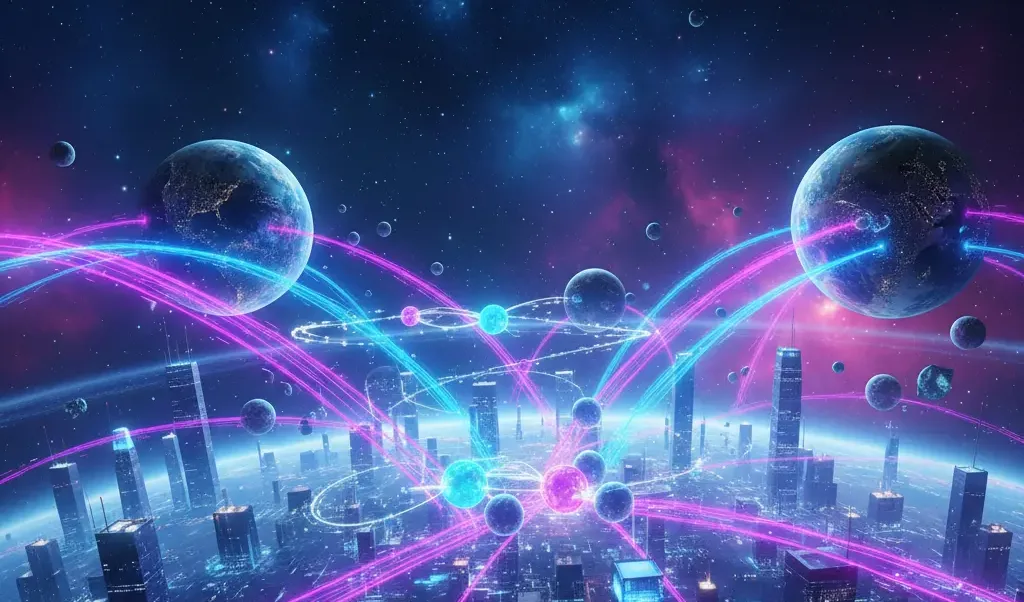
As digital threats grow more sophisticated, traditional cybersecurity methods are no longer enough to protect sensitive information. From financial data breaches to large-scale cyberattacks, the digital world is facing a security crisis. Enter quantum communication, a groundbreaking technology that provides security rooted not in mathematics, but in the laws of physics themselves. This technology promises a future where communication is unhackable, tamper-proof, and faster than anything we have today.
In this article, we explore what quantum communication is, how it works, why it matters, and how it will shape the future of cybersecurity and global communication networks.
What Is Quantum Communication?
Quantum communication is a method of transmitting information using particles like photons that follow the principles of quantum mechanics. These particles exist in fragile quantum states that collapse when observed — meaning any eavesdropping attempt can be instantly detected.
This is radically different from classical communication, which uses electrical signals or optical fibers that can be intercepted without detection. Quantum communication, by contrast, provides a system where monitoring the message destroys the message.
How It Differs from Classical Communication
| Classical Communication | Quantum Communication |
|---|---|
| Uses electrical signals or photons | Uses quantum states of particles |
| Can be intercepted secretly | Cannot be intercepted without detection |
| Vulnerable to modern hacking | Physically unhackable |
| Relies on complex math | Relies on physics laws |
Quantum communication offers a level of security that even supercomputers cannot break.
How It Works
Quantum communication typically relies on three major quantum phenomena:
1. Quantum Entanglement
A mysterious property where two particles remain connected regardless of distance. Changing one instantaneously affects the other. This allows secure transmission of information because any interference breaks the entanglement.
2. Quantum Key Distribution (QKD)
QKD allows two users to create encryption keys using polarized photons.
The two most popular protocols are:
BB84 – Uses photon polarization (up, down, left, right)
E91 – Uses entangled photons
If someone tries to observe or copy the photons during transmission, the photon states collapse, alerting the system.
3. Quantum Teleportation
Not the teleportation seen in science fiction — instead, it transfers quantum states from one particle to another over distance.
Benefits
Unbreakable Security
Because of the no-cloning theorem, quantum data cannot be copied. Any interception instantly becomes visible.
Tamper-Proof Transmission
The receiver immediately knows if the communication channel has been compromised.
Ultra-Fast Processing
Quantum networks can transmit information faster and more efficiently, especially when paired with quantum computers.
Real-World Applications
Banks in the financial sector are actively testing Quantum Key Distribution (QKD) to significantly improve the security of interbank transactions and ATM networks. By using quantum encryption, banks aim to protect sensitive data from increasingly advanced cyber threats. Similarly, military and government agencies are adopting quantum-encrypted communication lines to safeguard classified information and prevent espionage. One of the most impressive developments in this field comes from space-based quantum communication. China’s Micius satellite has successfully demonstrated quantum communication in space, offering a glimpse into the future of a fully secure global quantum internet.
Challenges and Limitations
Despite its promise, quantum communication faces hurdles:
High cost of equipment and infrastructure
Fragility of quantum states over long distances
Need for quantum repeaters and networks
Complexity of real-world deployment
However, global investments are accelerating solutions.
The Future
The next decade will bring:
Quantum Internet
A fully secure, global communication network powered by quantum entanglement.
AI-Enhanced Quantum Networks
Artificial intelligence will optimize quantum routing and error correction.
Global QKD Infrastructure
Governments and corporations will build interconnected quantum-secure networks.
The future of communication is quantum — and it’s already unfolding.
Quantum communication represents one of the most important technological breakthroughs of the 21st century. With unbreakable encryption, tamper-proof data transfer, and unprecedented speed, it promises a future where cyberattacks may become obsolete. As governments, banks, and tech companies invest heavily in quantum networks, the world is rapidly moving toward a new era of secure, physics-based communication.
Read more: Google Nano Banana AI: Features, Pricing & How It Works in 2025