

Working remotely in India sounds dreamy — mountains, beaches, forests, culture, food, and a slower rhythm of life. But the dream quickly collapses the moment your Wi-Fi drops during a client call, or when your UPI payment fails in a remote café, or when the power cuts exactly when your laptop battery hits 10%.
This guide is not another “top 10 apps everyone knows” list. This is a professional, field-tested survival guide created from real-world challenges digital nomads face every single day in India.
Every tool on this list is chosen because it prevents failure, saves money, protects your work, and keeps you sane in a country where network, power, and logistics can make or break your workation. These truly essential apps for workation in India are what separate a smooth remote-work life from a stressful one.
If you want a smooth, stress-free workation in India — these apps are your non-negotiables.
Part 1: Power & Connectivity Stack
Because In India, Your Work Completely Depends On These
1. Google Maps + MapmyIndia
Your Offline Navigation When Mobile Data Dies
India’s remote regions — Spiti, Ziro, Tawang, Gokarna, Araku Valley, Meghalaya interiors — are breathtaking, but network deserts are common. Even major carriers like Jio, Airtel, and Vi vanish without warning.
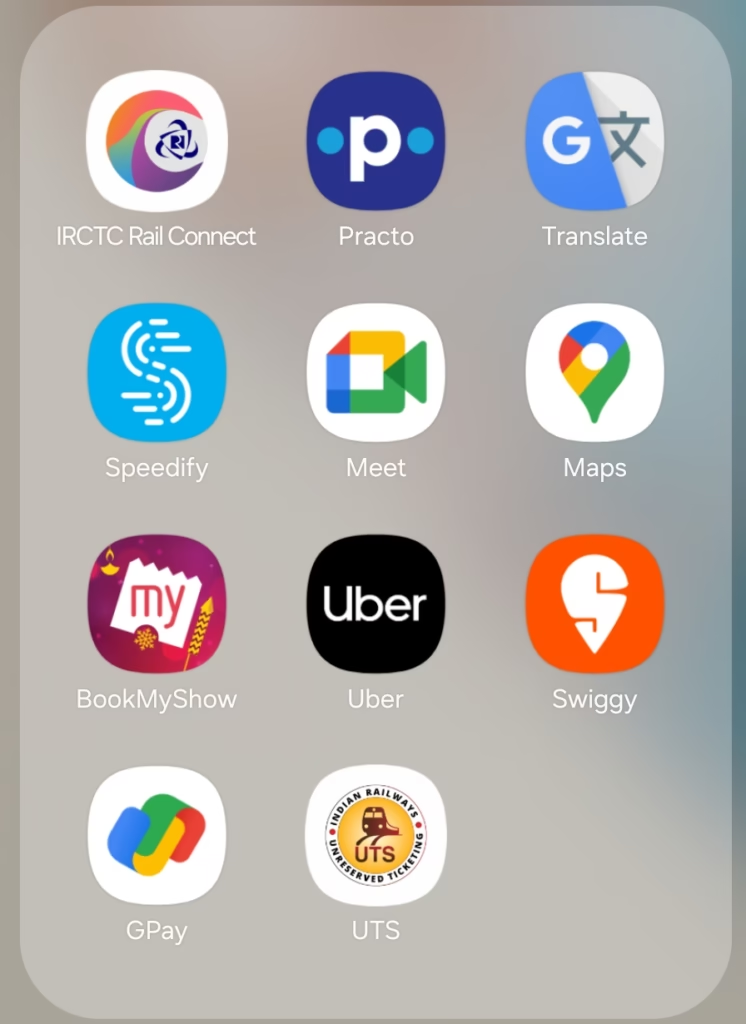
Why It’s Non-Negotiable: Google Maps lets you download large offline areas. MapmyIndia gives turn-by-turn voice guidance, 3D maps, and it is one of the best offline map app that works even when your phone is in airplane mode.
Real India Problem: You cannot depend on mobile internet in the hills or remote coastal areas.
If you get lost, you stay lost.
Nomad Impact Hack: Before booking your stay, zoom into the offline map and check:
- Distance to the nearest mobile tower
- Distance to the nearest hospital or clinic
- Location of coworking spaces or cafés
- Exact road conditions (small paths, steep climbs)
Most tourists never do this. Pro digital nomads always do. This single 2-minute check can save hours of confusion, expensive auto rides, and risky situations.
2. Luminous / Livguard Load Calculator
Predict Power Backup Before You Even Book Your Stay
Power cuts in India are not “rare incidents.” They are routine — especially in hill stations, small towns, and coastal regions.
Why It’s Non-Negotiable: Homestays often claim:
“Sir, inverter backup hai!”
But the truth? Most inverters cannot handle a laptop + WiFi router + phone charger for more than 40-60 minutes.
This app lets you calculate EXACT backup time.
What You Do: Ask your host one powerful question:
👉 “Your inverter battery is how many AH?”
Then enter that number in the app. You instantly know if the stay is safe for work or a productivity disaster.
Nomad Impact Hack: A 150AH battery = ~3-4 hours backup for basic work setup. A 100AH battery = ~1.5-2 hours. Anything below 80AH = Avoid if work depends on stability
Professional digital nomads use this calculation before paying anything. It’s one of the most underrated tools in India.
3. Speedify + NetMonster
The Anti-Internet-Failure Combo India Nomads Swear By. If Wi-Fi fails during a meeting — your reputation suffers. If hotspot drops — your client thinks you’re unprofessional. If tower strength is weak — nothing works. These two apps permanently solve these problems.
Speedify: Creates a bonded connection → Wi-Fi + Mobile Data work together. If one drops, the other takes over instantly. Zero call drops.
NetMonster: Shows the real-time strength of nearby towers and bands. You can find the exact corner of the house with the best signal.
Nomad Impact Hack: Use NetMonster before buying a SIM in a new location.
If the area is strong on Airtel Band 1 → buy Airtel. If Jio Band 5 looks best → buy Jio.
This removes guesswork and gives you rock-solid connectivity anywhere in India.
Part 2: India Logistics Stack
Payments. Transport. Trust. Without These — Chaos.
4. Google Pay + Paytm
The UPI Toolkit Every Nomad Must Carry
India is the world’s first truly UPI-first economy. 90% of your payments — chai stall, taxi, café, homestay — will happen through UPI. But relying on just one app is risky.
Why Both Matter:
- Google Pay → Best for quick person-to-person payments
- Paytm → Best for autos, tolls, FASTag, local shops, and small vendors
Real India Problem: Some places can face UPI downtime during peak hours.
Nomad Impact Hack: When UPI fails due to low internet:
Turn OFF mobile data → Turn ON hotspot → Retry. UPI needs extremely low bandwidth, so hotspot often stabilizes the connection. But always carry cash for backup.
This trick works everywhere — from Manali to Meghalaya.
5. Uber + Ola + Rapido
Transport Without Being Stranded. Big cities like Bangalore and Delhi support Ola + Uber. Small cities? Not reliable. Hill towns? Forget it.
Why These Apps Matter:
- Uber & Ola → Compare prices, reduce wait time
- Rapido → Bike taxi with lower cost.
Google Maps Listing → Save local taxi numbers as backup
Real India Problem: Frequent ride cancellations — especially for card payments. Many drivers ask riders to cancel and go off-app at the same price to avoid paying commission, which can be dangerous since the trip is no longer tracked or insured.
Nomad Impact Hack: Switch to Cash/UPI mode — cancellations can drop by 80–90%. This simple trick cuts most of the frustration in Indian cities. Or choose ‘Go with Meter’ for the most reliable ride.
6. IRCTC + MakeMyTrip
Smart Inter-City Travel Planning India’s train system is huge, fast, and budget-friendly — but unpredictable.
Why You Need Both:
- IRCTC → Official, real seat availability(Also use UTS for buying ticket)
- MMT → Best for cheap last-minute flights and hotel deals
Nomad Impact Hack: Check your train PNR after 10:00 PM. That’s when most cancellations get processed. Many digital nomads have seen their Waiting List → Confirmed only because they checked at the correct time.
Part 3: Productivity + Wellness Stack
Because Nomad Life Isn’t Just Work — It’s Well-Being
7. Zoom / Google Meet (Low Data Mode)
Meetings That Don’t Break In Poor Network Zones. Indian network conditions can shift rapidly — especially in homestays where routers are outdated.
Why It’s Essential: Low Data Mode helps you keep calls stable even on 0.5–1 Mbps connection.
Nomad Impact Hack: Use Zoom on mobile hotspot, not homestay Wi-Fi. Mobile networks are often more stable than cheap routers.
8. Google Translate
Breaking Language Walls Across India’s 22+ Languages. North-East = different languages. South India = different languages. Hills = different dialects. You will face communication challenges.
Why It’s Essential: Offline packs. Instant camera scan for menus. Conversation mode for real-time speech translation.
Nomad Impact Hack: Download these offline before traveling: Hindi, Bengali, Tamil, Kannada, Marathi. These five cover 80% of your interactions in India.
9. Zomato + Swiggy
Safe Food Even When You Can’t Step Out. New city = Unknown restaurants. Your stomach doesn’t care that you’re a digital nomad.
Food poisoning is the #1 reason nomads lose work days. Why These Apps Matter:
- Zomato → Better reviews and hygiene data
- Swiggy → Faster delivery and wider restaurant network
Nomad Impact Hack: Sort by Most Ordered, not Rating. This reveals the community-trusted restaurants. Local wisdom > star ratings.
10. Practo
Your Emergency Medical Support System. Falling sick away from home is stressful.
Finding a trustworthy doctor is harder.
Why It’s Essential:
- Verified doctors
- 24×7 teleconsultations
- Medicine ordering
- Nearby hospital listings
Nomad Impact Hack: If you’re unsure whether your symptoms need urgent care —
do a 15-minute teleconsultation first. Doctors guide you instantly — no panic, no guessing.
These Apps Are Not Optional. They Are Your Entire Workation Survival Framework. Working remotely in India is one of the richest experiences possible — culturally, spiritually, creatively. But the only way to succeed is to prepare for India’s real challenges:
✔ Power cuts
✔ Network instability
✔ Transport unpredictability
✔ UPI downtime
✔ Food safety
✔ Language gaps
With this stack, you become resilient, efficient, and unstoppable anywhere in India — from Ladakh to Kerala, from Goa to Guwahati.
This is the app toolkit that separates a tourist with a laptop from a true workation warrior.
Read more: The $0 Upgrade: How to Optimize a Slow Laptop for Digital Nomad Life (No Buying New Gear)


